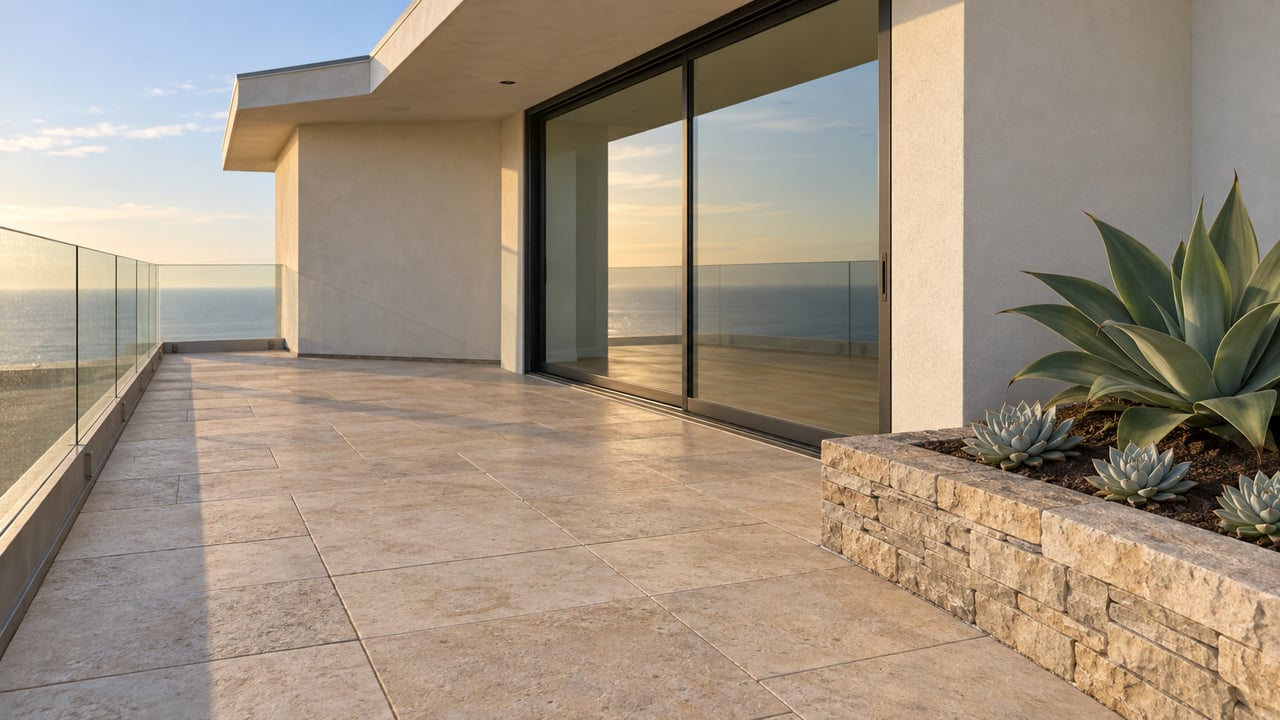
How Many Years Are Left on the Permit Protecting Your Solana Beach Bluff?
October 1, 2026
October 1, 2026
Most sellers on Pacific Avenue or along the rest of Solana Beach's coastal bluff couldn't answer that question if you asked them directly. Yet the answer sits in a city file, tied to a specific parcel, with a specific expiration date attached to the concrete wall holding their backyard in place.
Take a house on Pacific Avenue that the California Coastal Commission approved for a seawall extension. The home was valued at $4.3 million, and at the time of approval its most seaward point sat 22 feet from the edge of a 90-foot bluff. The Coastal Commission's own standard calls for a 40-foot setback, with structures required to come down once they're within 10 feet of the edge. The seawall closed a 50-foot gap in an otherwise continuous wall protecting a row of houses along that stretch. It also came with conditions: a $54,631 public access mitigation fee, a $10,272 sand mitigation fee, a permit good for 20 years, and a requirement that the wall be removed if the home is significantly remodeled or rebuilt before that clock runs out. A deed restriction from the 1990s already prohibited new shoreline protection at that address as part of an earlier rebuild.
None of that shows up in a casual walkthrough of a blufftop listing. It shows up in the coastal development permit file at the city and in the chain of title, which is exactly why it's worth pulling before a home goes on the market, not after an offer is already in escrow.
A seawall on a Solana Beach bluff is not a permanent fixture in the way a roof or a foundation is. It's a leased protection with an end date. The city's shoreline protection ordinance, in place since 1994, ties every armoring approval to conditions that outlive the original owner: mitigation fees for public beach access lost to the wall's footprint, sand replacement fees to offset what the structure keeps from naturally eroding onto the beach, and a permit term that typically runs 20 years before the homeowner has to come back and either justify keeping the wall or take it out.
The 20-year clock resets differently depending on what happens to the house above it. If a bluff-top home undergoes a substantial remodel or gets rebuilt, the armoring protecting it can be required to come down regardless of how many years are left on the original permit. That single condition is worth more to a buyer's due diligence than almost anything else on a standard disclosure form, because it determines whether the addition or rebuild they're planning is even compatible with keeping the wall that currently protects the lot.
Solana Beach's certified Local Coastal Program does not treat bluff erosion as a single flat number. The plan assumes a retreat rate of 0.4 feet per year through 2025, then steps that assumption up to 0.673 feet per year for 2026 through 2046.
| Period | Assumed annual bluff retreat |
|---|---|
| 2016 to 2025 | 0.4 feet per year |
| 2026 to 2046 | 0.673 feet per year |
That escalation is not a forecast pulled from a state agency's regional model. It's the specific number Solana Beach's own planning documents use to calculate mitigation fees and setback lines on this stretch of coast, and it already assumes bluffs here will erode faster over the next two decades than they did over the last ten.
Separately, new statewide guidance on coastal bluff setbacks that took effect in July 2026 moved away from a single countywide erosion average toward segment-specific modeling. That update flagged Del Mar, Solana Beach, and San Onofre as sections of coast where measured retreat exceeded the broader regional figure used for stretches like La Jolla. Two different data sources, one already written into Solana Beach's code and one just adopted statewide, are pointing the same direction: this particular stretch of coast doesn't get to use the generic Southern California erosion number.
California requires new coastal development to plan for a 75-year structural life. That figure isn't negotiable downward. A property owner can't shorten the design life to shrink the required setback, even if they only intend to keep the structure for a fraction of that time, because the rule exists to protect whoever owns the home decades from now, not just the person building it today.
Run the arithmetic and the reasoning becomes concrete. A bluff eroding at roughly 4 inches a year, multiplied across a 75-year design life, adds up to roughly 25 feet of erosion-projection setback on its own, before any additional buffer for geologic stability gets layered on top. Change the assumed rate even slightly and that number moves, which is exactly what's happening as Solana Beach's own code and the state's new segment-specific data both point toward faster retreat than older, broader estimates assumed.
The California Coastal Act is explicit about why the setback has to be generous enough to avoid needing a seawall in the first place. Section 30253 prohibits new development that would in any way require construction of protective devices. The rule is built so that by the time a bluff retreats far enough to threaten a house, the house is already due for replacement rather than in need of rescue.
Solana Beach's policy on this point has already been tested in court. In Beach and Bluff Conservancy v. City of Solana Beach, a California appellate court upheld the city's authority to refuse extending seawall protection to new coastal development, ruling the policy at least facially constitutional. New construction and substantial remodels on a bluff lot cannot count on inheriting the same armoring protection that an existing older home might have.
That distinction matters for a seller weighing whether to remodel before listing versus selling as-is. A light cosmetic update likely leaves an existing seawall's permit untouched. A significant rebuild can trigger the requirement to remove the wall and reapply under current, tighter setback standards, which is a materially different negotiation than the one a buyer expects when they see a protected bluff lot with an ocean view.
A few documents answer questions a standard disclosure packet won't:
None of this replaces a geotechnical evaluation specific to the lot. It does mean a seller walks into that evaluation, and into conversations with a buyer's agent, already knowing what's recorded rather than finding out mid-escrow.
Does every bluff-top home in Solana Beach have a seawall? No. Some rely on setback distance alone, and the city's preferred approach for a threatened bluff without existing armoring often starts with seacave or notch infill rather than a full seawall, which is treated differently under the city's ordinance.
Can a buyer simply extend an existing seawall permit after purchase? Not automatically. Permits are tied to conditions set at approval, including remodel triggers, and the city's authority to decline extending protection to new development has already been upheld on appeal.
Is the erosion rate the same for every lot in Solana Beach? The city's Local Coastal Program uses planning-wide assumptions for its fee and setback calculations, but a site-specific geotechnical report can show different retreat behavior depending on bluff geology and prior armoring at that exact location.
If you're weighing whether to list a Solana Beach bluff-top property this year, or trying to understand what a specific seawall permit actually protects before you buy, Adrienne Mineiro can help you pull the file and read it correctly before you're negotiating against someone who already has.
Experience a customized approach tailored to your unique real estate needs. Adrienne prioritizes your goals and ensures a seamless process from start to finish.